PLC-Based Steam Boiler Control in Structured Text (ST). A Practical Handbook
Content: Steamboiler_Control_Complete.pdf (837.50 KB)
Uploaded: 31.07.2026
Positive responses: -1
Negative responses: 0
Sold: -1
Refunds: -1
~ $3.49
The exact amount is on the payment page
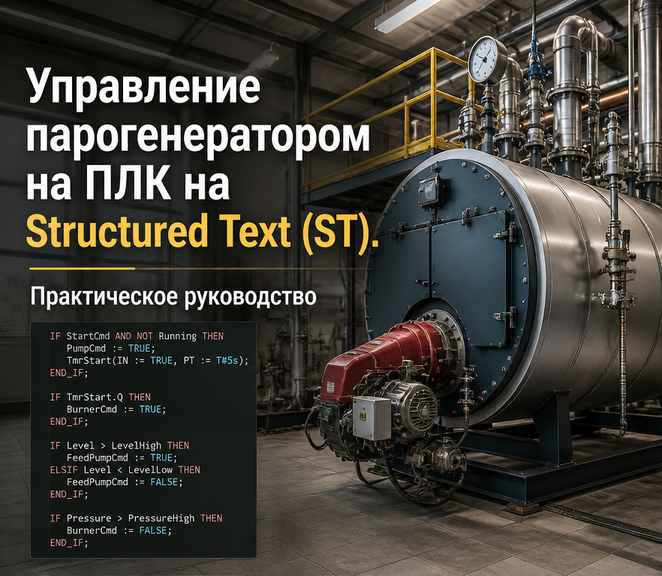
This practical guide is intended for automation engineers, PLC programmers, and boiler commissioning specialists. It covers in detail the automation of steam boilers — from physical fundamentals to the implementation of advanced control algorithms in Structured Text (ST) according to IEC 61131-3.
A steam boiler is a high-risk facility with complex dynamics. Control errors can lead to accidents, explosions, and severe consequences. Therefore, the automation system must be not only efficient but also highly reliable, with multi-level protection.
The book systematically covers:
Physical fundamentals of steam boilers: thermodynamics of saturated steam, energy balance, process dynamics.
Safety system — multi-level protection: Low Water Cut-Off, High Pressure Trip, flame monitoring, safety valves, E-Stop.
Control system architecture — sensors (pressure, level, flow, temperature, O₂, flame), actuators (gas valves, dampers, pumps), operator interface (HMI/SCADA), redundancy.
PID control — theory and practical tuning for steam boilers: proportional, integral, derivative terms, anti-windup, rate-limiting.
Water level control — three schemes: single-element (On/Off), two-element (level + steam flow), three-element (level + steam flow + feedwater flow) with full compensation for swell & shrink effects.
Burner Management System (BMS) — start-up, ignition, flame control, emergency shutdown sequences; state machine in ST.
Cascade control — pressure-power, fuel-air ratio; improved control quality.
Boiler cascade control — master-slave, start/stop algorithms, load distribution, rotation for even wear.
Complete code examples in ST with comments — ready-to-use function blocks for PID, BMS, three-element level control, and cascade management.
The book includes theoretical explanations, thermodynamic tables, diagrams, graphs, calculation formulas, and ready-made code that can be directly used in CoDeSys, TwinCAT, and other IEC 61131-3 environments.
This guide is useful for automation engineers, PLC programmers, boiler commissioning specialists, students and teachers of technical disciplines. It will help you create a reliable, efficient, and safe steam boiler control system that complies with industrial safety standards (GOST, TR TS, NFPA).
A steam boiler is a high-risk facility with complex dynamics. Control errors can lead to accidents, explosions, and severe consequences. Therefore, the automation system must be not only efficient but also highly reliable, with multi-level protection.
The book systematically covers:
Physical fundamentals of steam boilers: thermodynamics of saturated steam, energy balance, process dynamics.
Safety system — multi-level protection: Low Water Cut-Off, High Pressure Trip, flame monitoring, safety valves, E-Stop.
Control system architecture — sensors (pressure, level, flow, temperature, O₂, flame), actuators (gas valves, dampers, pumps), operator interface (HMI/SCADA), redundancy.
PID control — theory and practical tuning for steam boilers: proportional, integral, derivative terms, anti-windup, rate-limiting.
Water level control — three schemes: single-element (On/Off), two-element (level + steam flow), three-element (level + steam flow + feedwater flow) with full compensation for swell & shrink effects.
Burner Management System (BMS) — start-up, ignition, flame control, emergency shutdown sequences; state machine in ST.
Cascade control — pressure-power, fuel-air ratio; improved control quality.
Boiler cascade control — master-slave, start/stop algorithms, load distribution, rotation for even wear.
Complete code examples in ST with comments — ready-to-use function blocks for PID, BMS, three-element level control, and cascade management.
The book includes theoretical explanations, thermodynamic tables, diagrams, graphs, calculation formulas, and ready-made code that can be directly used in CoDeSys, TwinCAT, and other IEC 61131-3 environments.
This guide is useful for automation engineers, PLC programmers, boiler commissioning specialists, students and teachers of technical disciplines. It will help you create a reliable, efficient, and safe steam boiler control system that complies with industrial safety standards (GOST, TR TS, NFPA).
Introduction — purpose, scope, physical fundamentals, safety requirements.
Theoretical background — saturated steam properties, energy balance, dynamics, time constants, critical parameters.
System architecture — sensors (pressure, level, flow, temperature, O₂, flame), actuators, HMI/SCADA, redundancy, PLC selection.
Safety system — multi-level protection, Low-Low level, High-High pressure, flame monitoring, E-Stop, safety valves, error codes.
Parameter monitoring — measurement and scaling of pressure, level, flow, temperature, O₂; filtering and compensation.
PID control fundamentals — theory, tuning, discrete implementation, anti-windup, Ziegler-Nichols, practical tuning.
Steam pressure control — cascade control, tuning, disturbance rejection, rate-limiting.
Water level control — single-element, two-element, three-element control; complete code; selection guidelines; boiler house project example.
Burner Management System (BMS) — sequences, state machine, flame detection, filtering, flame failure detection.
Cascade control systems — pressure-power, fuel-air ratio; programming and application.
Boiler cascade control — master-slave concept, hysteresis, load distribution, rotation, full ST algorithm.
Conclusion — key principles, recommendations, references to standards.
Theoretical background — saturated steam properties, energy balance, dynamics, time constants, critical parameters.
System architecture — sensors (pressure, level, flow, temperature, O₂, flame), actuators, HMI/SCADA, redundancy, PLC selection.
Safety system — multi-level protection, Low-Low level, High-High pressure, flame monitoring, E-Stop, safety valves, error codes.
Parameter monitoring — measurement and scaling of pressure, level, flow, temperature, O₂; filtering and compensation.
PID control fundamentals — theory, tuning, discrete implementation, anti-windup, Ziegler-Nichols, practical tuning.
Steam pressure control — cascade control, tuning, disturbance rejection, rate-limiting.
Water level control — single-element, two-element, three-element control; complete code; selection guidelines; boiler house project example.
Burner Management System (BMS) — sequences, state machine, flame detection, filtering, flame failure detection.
Cascade control systems — pressure-power, fuel-air ratio; programming and application.
Boiler cascade control — master-slave concept, hysteresis, load distribution, rotation, full ST algorithm.
Conclusion — key principles, recommendations, references to standards.
No feedback yet