Industrial Greenhouse Microclimate Control in Structured Text (ST)
Content: greenhouse_complete.pdf (587.14 KB)
Uploaded: 31.07.2026
Positive responses: -1
Negative responses: 0
Sold: -1
Refunds: -1
~ $3.53
The exact amount is on the payment page
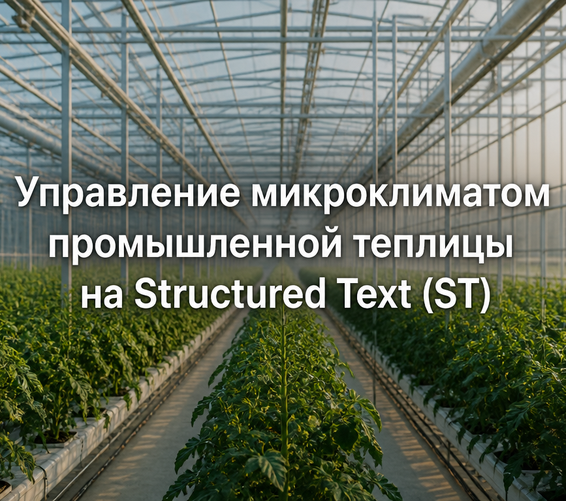
Modern industrial crop cultivation is impossible without precise and reliable microclimate control. Temperature, humidity, lighting, CO₂ concentration, and irrigation — each of these parameters directly affects plant growth, health, and yield. Control errors lead to crop losses, plant diseases, and unnecessary energy costs.
This training manual is dedicated to the automation of industrial greenhouses using PLCs with Structured Text (ST) according to IEC 61131-3. It systematically covers all aspects of building a complete microclimate control system — from physical fundamentals to multi-zone algorithms and SCADA integration.
The book covers in detail:
Physical fundamentals of microclimate: energy balance, humidity and dew point, photosynthesis, heat transfer laws, air stratification.
Heating and cooling system — architecture, temperature sensors, PID control with anti-windup, tuning, hysteresis, manual mode.
Ventilation and air exchange — ventilation types, damper and fan control, power calculation, ST function block.
Humidity control — problems of high and low humidity, humidification technologies (aerosol, steam, evaporative) and dehumidification (ventilation, adsorption and condensation dryers), ST function block.
Lighting and supplemental lighting — light spectrum, measurement units, natural light compensation, spectrum control (red/blue), energy saving.
CO₂ control — role of carbon dioxide in photosynthesis, CO₂ sources, sensors, two-position regulation, optimisation based on light.
Irrigation and fertigation — soil moisture sensors, irrigation strategies (scheduled, sensor-based, combined), radiation adaptation, pH and EC control.
Multi-zone control — dividing greenhouse into climate zones, data structures, ST program organisation, coordination level, crop recipes.
Forecasting and optimisation — weather forecast integration, setpoint adaptation, machine learning for demand prediction, energy efficiency, yield prediction.
System architecture and deployment — multi-level architecture (sensors, PLC, SCADA, cloud), communication protocols (Modbus), SCADA configuration examples, redundancy, safety, deployment process, typical problems and solutions.
All algorithms are accompanied by ready-to-use ST code with comments, which can be adapted for specific projects in CoDeSys, TwinCAT, and other IEC 61131-3 environments.
The manual is intended for automation engineers, PLC programmers, agronomists, students and teachers involved in greenhouse automation. It will help create an efficient, reliable and energy-saving control system that increases yield and reduces operating costs.
This training manual is dedicated to the automation of industrial greenhouses using PLCs with Structured Text (ST) according to IEC 61131-3. It systematically covers all aspects of building a complete microclimate control system — from physical fundamentals to multi-zone algorithms and SCADA integration.
The book covers in detail:
Physical fundamentals of microclimate: energy balance, humidity and dew point, photosynthesis, heat transfer laws, air stratification.
Heating and cooling system — architecture, temperature sensors, PID control with anti-windup, tuning, hysteresis, manual mode.
Ventilation and air exchange — ventilation types, damper and fan control, power calculation, ST function block.
Humidity control — problems of high and low humidity, humidification technologies (aerosol, steam, evaporative) and dehumidification (ventilation, adsorption and condensation dryers), ST function block.
Lighting and supplemental lighting — light spectrum, measurement units, natural light compensation, spectrum control (red/blue), energy saving.
CO₂ control — role of carbon dioxide in photosynthesis, CO₂ sources, sensors, two-position regulation, optimisation based on light.
Irrigation and fertigation — soil moisture sensors, irrigation strategies (scheduled, sensor-based, combined), radiation adaptation, pH and EC control.
Multi-zone control — dividing greenhouse into climate zones, data structures, ST program organisation, coordination level, crop recipes.
Forecasting and optimisation — weather forecast integration, setpoint adaptation, machine learning for demand prediction, energy efficiency, yield prediction.
System architecture and deployment — multi-level architecture (sensors, PLC, SCADA, cloud), communication protocols (Modbus), SCADA configuration examples, redundancy, safety, deployment process, typical problems and solutions.
All algorithms are accompanied by ready-to-use ST code with comments, which can be adapted for specific projects in CoDeSys, TwinCAT, and other IEC 61131-3 environments.
The manual is intended for automation engineers, PLC programmers, agronomists, students and teachers involved in greenhouse automation. It will help create an efficient, reliable and energy-saving control system that increases yield and reduces operating costs.
Physical fundamentals of microclimate — energy balance, humidity and dew point, photosynthesis and three limiting factors, heat transfer laws, air stratification.
Heating and cooling system — architecture, heat transfer, temperature sensor types (RTD, thermistors, digital), PID control (theory, discrete implementation, anti-windup, tuning), hysteresis, manual mode.
Ventilation and air exchange — ventilation physics, system types (exhaust, supply, balanced, circulation), damper and fan control, power calculation, ST function block.
Humidity control — plant needs, problems of incorrect humidity, humidification technologies (aerosol, steam, evaporative) and dehumidification (ventilation, adsorption and condensation dryers), ST function block.
Lighting and supplemental lighting — light spectrum and photosynthesis, measurement units (lux, PPFD), light sources (HPS, LED), natural light compensation, spectrum control (red/blue), energy saving, ST function block.
CO₂ supply system — role of CO₂ in photosynthesis, sources (gas burners, cylinders), NDIR sensors, two-position regulation, light-based optimisation, ST function block.
Irrigation and fertigation system — plant water needs, soil moisture sensors (capacitive), irrigation strategies (scheduled, sensor-based, combined), radiation adaptation, nutrient management (pH, EC), ST function blocks.
Multi-zone greenhouse control — multi-zone concept, physical and logical architecture, data structures, ST program organisation, coordination level, crop recipes.
Forecasting and optimisation — weather forecast integration, setpoint adaptation, machine learning for demand prediction, energy efficiency optimisation, yield prediction.
System architecture, SCADA and deployment — multi-level architecture (field level, PLC, SCADA, cloud), communication protocols (Modbus), SCADA (Ignition-based), safety and reliability, deployment process, typical problems and solutions, documentation, possible extensions.
Heating and cooling system — architecture, heat transfer, temperature sensor types (RTD, thermistors, digital), PID control (theory, discrete implementation, anti-windup, tuning), hysteresis, manual mode.
Ventilation and air exchange — ventilation physics, system types (exhaust, supply, balanced, circulation), damper and fan control, power calculation, ST function block.
Humidity control — plant needs, problems of incorrect humidity, humidification technologies (aerosol, steam, evaporative) and dehumidification (ventilation, adsorption and condensation dryers), ST function block.
Lighting and supplemental lighting — light spectrum and photosynthesis, measurement units (lux, PPFD), light sources (HPS, LED), natural light compensation, spectrum control (red/blue), energy saving, ST function block.
CO₂ supply system — role of CO₂ in photosynthesis, sources (gas burners, cylinders), NDIR sensors, two-position regulation, light-based optimisation, ST function block.
Irrigation and fertigation system — plant water needs, soil moisture sensors (capacitive), irrigation strategies (scheduled, sensor-based, combined), radiation adaptation, nutrient management (pH, EC), ST function blocks.
Multi-zone greenhouse control — multi-zone concept, physical and logical architecture, data structures, ST program organisation, coordination level, crop recipes.
Forecasting and optimisation — weather forecast integration, setpoint adaptation, machine learning for demand prediction, energy efficiency optimisation, yield prediction.
System architecture, SCADA and deployment — multi-level architecture (field level, PLC, SCADA, cloud), communication protocols (Modbus), SCADA (Ignition-based), safety and reliability, deployment process, typical problems and solutions, documentation, possible extensions.
No feedback yet