Function Blocks in Structured Text (ST): Theory and Practice of PLC Programming
Content: Funktsionalnye-Bloki-ST.pdf (912.26 KB)
Uploaded: 03.08.2026
Positive responses: -1
Negative responses: 0
Sold: -1
Refunds: -1
~ $3.53
The exact amount is on the payment page
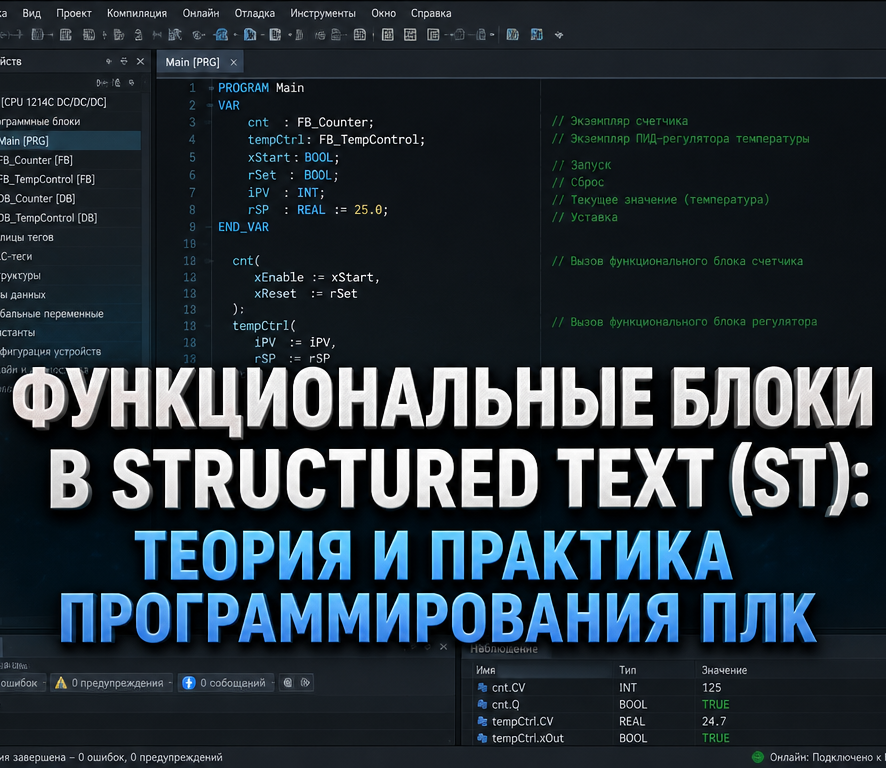
Function Blocks (FB) are the foundation of modern PLC programming according to the IEC 61131-3 standard. They enable modular, reusable, and easily maintainable code by encapsulating algorithms together with data. Unlike functions, function blocks have memory — they retain their state between calls, making them indispensable for real-time tasks: timers, counters, controllers, edge detectors, and complex state machines.
This practical guide is dedicated to the complete mastery of function blocks in Structured Text (ST). It systematically covers all aspects: from basic concepts to industrial library creation and SCADA integration.
The book covers in detail:
Fundamental concepts — what a function block is, how it differs from a function, block instances, declaration structure (VAR_INPUT, VAR_OUTPUT, VAR, VAR_TEMP), calling and initialisation.
Standard function blocks — full coverage of timers (TON, TOF, TP), counters (CTU, CTD, CTUD), triggers (R_TRIG, F_TRIG, RS, SR) with examples and explanations.
Designing custom blocks — interface design principles, state management via finite state machines (dishwasher example), error handling and protection, parametrisation and configuration (PID controller).
Function block composition — nested blocks, processing chains (filters, averaging), Observer pattern (system monitor).
Advanced techniques — blocks with arrays (multi-zone temperature control), blocks with timeouts, adaptive control.
Function block libraries — creation principles, benefits, industrial library structure, interface standardisation, versioning.
Testing and debugging — unit testing, logging and monitoring, simulation and emulation (tank simulator).
Performance optimisation — execution time analysis, algorithm optimisation, memory management.
SCADA integration — HMI interface, trends and archiving.
All algorithms are accompanied by ready-to-use ST code with comments, adaptable for specific projects in CoDeSys, TwinCAT, and other IEC 61131-3 environments. The book contains numerous practical examples: from a simple rising edge detector to a complex pump station with rotation, a monitoring system, and a soft starter.
The manual is intended for automation engineers, PLC programmers, students and teachers. It will help you move from writing "spaghetti code" to architecturally sound, modular, and reliable programs for industrial controllers.
This practical guide is dedicated to the complete mastery of function blocks in Structured Text (ST). It systematically covers all aspects: from basic concepts to industrial library creation and SCADA integration.
The book covers in detail:
Fundamental concepts — what a function block is, how it differs from a function, block instances, declaration structure (VAR_INPUT, VAR_OUTPUT, VAR, VAR_TEMP), calling and initialisation.
Standard function blocks — full coverage of timers (TON, TOF, TP), counters (CTU, CTD, CTUD), triggers (R_TRIG, F_TRIG, RS, SR) with examples and explanations.
Designing custom blocks — interface design principles, state management via finite state machines (dishwasher example), error handling and protection, parametrisation and configuration (PID controller).
Function block composition — nested blocks, processing chains (filters, averaging), Observer pattern (system monitor).
Advanced techniques — blocks with arrays (multi-zone temperature control), blocks with timeouts, adaptive control.
Function block libraries — creation principles, benefits, industrial library structure, interface standardisation, versioning.
Testing and debugging — unit testing, logging and monitoring, simulation and emulation (tank simulator).
Performance optimisation — execution time analysis, algorithm optimisation, memory management.
SCADA integration — HMI interface, trends and archiving.
All algorithms are accompanied by ready-to-use ST code with comments, adaptable for specific projects in CoDeSys, TwinCAT, and other IEC 61131-3 environments. The book contains numerous practical examples: from a simple rising edge detector to a complex pump station with rotation, a monitoring system, and a soft starter.
The manual is intended for automation engineers, PLC programmers, students and teachers. It will help you move from writing "spaghetti code" to architecturally sound, modular, and reliable programs for industrial controllers.
Fundamental concepts — FB definition, difference from functions, instances, declaration structure (VAR_INPUT, VAR_OUTPUT, VAR, VAR_TEMP, VAR_IN_OUT), calling and initialisation, examples.
Standard function blocks — timers (TON, TOF, TP), counters (CTU, CTD, CTUD), triggers (R_TRIG, F_TRIG, RS, SR), applications.
Designing custom blocks — interface principles, finite state machines (dishwasher), error handling and protection (motor), parametrisation (PID controller).
Function block composition — nested blocks (pump station with rotation), processing chains (filter, moving average, sensor processor), Observer pattern (system monitor).
Advanced techniques — blocks with arrays (multi-zone temperature control), blocks with timeouts, adaptive control.
Function block libraries — benefits, creation principles, library structure, standardisation, versioning, examples (start-stop, soft starter).
Testing and debugging — unit testing, logging and monitoring, simulation (tank), using simulators.
Performance optimisation — execution time analysis, algorithm optimisation, memory management.
SCADA integration — HMI interface, trends and archiving.
Appendix — reference table of standard blocks.
Standard function blocks — timers (TON, TOF, TP), counters (CTU, CTD, CTUD), triggers (R_TRIG, F_TRIG, RS, SR), applications.
Designing custom blocks — interface principles, finite state machines (dishwasher), error handling and protection (motor), parametrisation (PID controller).
Function block composition — nested blocks (pump station with rotation), processing chains (filter, moving average, sensor processor), Observer pattern (system monitor).
Advanced techniques — blocks with arrays (multi-zone temperature control), blocks with timeouts, adaptive control.
Function block libraries — benefits, creation principles, library structure, standardisation, versioning, examples (start-stop, soft starter).
Testing and debugging — unit testing, logging and monitoring, simulation (tank), using simulators.
Performance optimisation — execution time analysis, algorithm optimisation, memory management.
SCADA integration — HMI interface, trends and archiving.
Appendix — reference table of standard blocks.
No feedback yet