PLC Analog Outputs (DAC): Controlling Valves, Drives, and Heaters via 4–20 mA
Content: Аналоговые выходы ЦАП в ПЛК_ управление клапанами, приводами и нагревателями через 4–20 мА.pdf (4.31 MB)
Uploaded: 04.08.2026
Positive responses: -1
Negative responses: 0
Sold: -1
Refunds: -1
~ $3.54
The exact amount is on the payment page
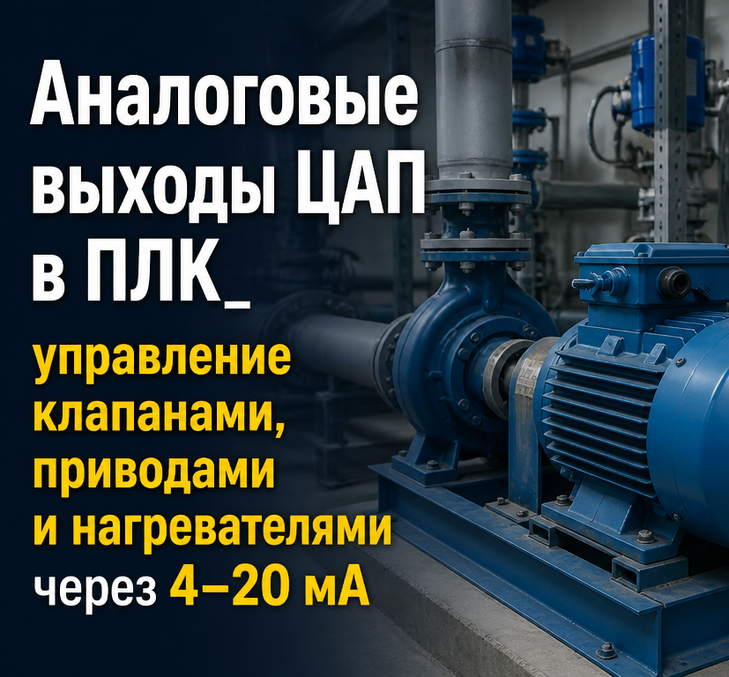
PLC analog outputs are channels through which the controller transmits a continuous control signal to the outside world. Unlike a discrete output that can only turn a load on or off, an analog output generates a smoothly varying current or voltage proportional to the digital value from the program. In practice, this means the PLC can not just "open a valve" but hold it at 37%, accelerate a drive to the exact required speed, or maintain a precise heater power level.
This practical guide is dedicated to the complete mastery of PLC analog outputs using Structured Text (ST) according to IEC 61131-3. It systematically covers all aspects: from DAC physics and current loops to programming, diagnostics, and laboratory exercises.
The book covers in detail:
DAC physics — operating principle, resolution, non-linearity parameters (INL, DNL), numerical codes in registers of different PLC platforms.
UNSCALE mathematics — converting engineering values to DAC code, normalisation, formulas, output anti-windup.
ST implementation — complete UNSCALE function block with division-by-zero protection, clamping, and rounding.
Valve control — setpoint scaling, PID flow control, writing to AO register.
Variable frequency drive (VFD) control — analog speed reference, ramp (smooth acceleration/deceleration), discrete Start/Stop commands, VFD fault handling.
Heater control — PID loop with anti-windup, thermal inertia, thyristor power regulator (TPM) control.
Accuracy and errors — error budget calculation, quantisation, INL, temperature drift, compliance voltage monitoring.
Analog output diagnostics — wire break detection, short circuit, overtemperature, power loss, expected vs measured current comparison.
Safety and reliability — protective wrapper block (FB_SafeAO) with limiting, ramping, safe state, fault acknowledgement.
Laboratory exercises — UNSCALE 5-point verification, valve positioner linearity test, heater plant identification via step response (Ziegler-Nichols), current loop fault diagnostics.
Appendices — 4–20 mA correspondence table, AO commissioning checklist, quick fault diagnosis guide.
All algorithms are accompanied by ready-to-use ST code with detailed comments. The book contains numerous practical examples: from a simple UNSCALE function to a complete safety wrapper for critical analog outputs.
The manual is intended for automation engineers, PLC programmers, commissioning engineers, students and teachers. It will help you master continuous process control via 4–20 mA and 0–10 V analog signals, correctly configure scaling, diagnose faults, and ensure safe operation of actuators.
This practical guide is dedicated to the complete mastery of PLC analog outputs using Structured Text (ST) according to IEC 61131-3. It systematically covers all aspects: from DAC physics and current loops to programming, diagnostics, and laboratory exercises.
The book covers in detail:
DAC physics — operating principle, resolution, non-linearity parameters (INL, DNL), numerical codes in registers of different PLC platforms.
UNSCALE mathematics — converting engineering values to DAC code, normalisation, formulas, output anti-windup.
ST implementation — complete UNSCALE function block with division-by-zero protection, clamping, and rounding.
Valve control — setpoint scaling, PID flow control, writing to AO register.
Variable frequency drive (VFD) control — analog speed reference, ramp (smooth acceleration/deceleration), discrete Start/Stop commands, VFD fault handling.
Heater control — PID loop with anti-windup, thermal inertia, thyristor power regulator (TPM) control.
Accuracy and errors — error budget calculation, quantisation, INL, temperature drift, compliance voltage monitoring.
Analog output diagnostics — wire break detection, short circuit, overtemperature, power loss, expected vs measured current comparison.
Safety and reliability — protective wrapper block (FB_SafeAO) with limiting, ramping, safe state, fault acknowledgement.
Laboratory exercises — UNSCALE 5-point verification, valve positioner linearity test, heater plant identification via step response (Ziegler-Nichols), current loop fault diagnostics.
Appendices — 4–20 mA correspondence table, AO commissioning checklist, quick fault diagnosis guide.
All algorithms are accompanied by ready-to-use ST code with detailed comments. The book contains numerous practical examples: from a simple UNSCALE function to a complete safety wrapper for critical analog outputs.
The manual is intended for automation engineers, PLC programmers, commissioning engineers, students and teachers. It will help you master continuous process control via 4–20 mA and 0–10 V analog signals, correctly configure scaling, diagnose faults, and ensure safe operation of actuators.
Introduction — analog outputs in industry, standard ranges (4–20 mA, 0–10 V), SCALE/UNSCALE symmetry logic.
PLC analog output module structure — functional blocks, output types (active/passive), DAC ICs.
Digital-to-analog conversion — DAC physics, resolution, INL, DNL, drift, numerical codes in different PLC registers.
UNSCALE mathematics — general formulas, normalisation, DAC code conversion, combined formula.
UNSCALE ST implementation — function block, division-by-zero protection, clamping, rounding.
Valve control — flow control valve example, PID controller, input and output scaling.
Variable frequency drive control — analog speed reference, ramp, discrete commands, fault handling.
Heater control — PID loop with anti-windup, thermal inertia, thyristor power regulator control.
Accuracy and errors — error budget calculation, error sources, compliance voltage monitoring.
Analog output diagnostics — wire break, short circuit, overtemperature detection, expected vs measured current comparison.
Safety and reliability — FB_SafeAO protective block, limiting, ramping, safe state, fault acknowledgement.
Laboratory exercises — UNSCALE verification, valve linearity, heater identification, fault diagnostics.
Appendices — 4–20 mA table, commissioning checklist, quick diagnostics.
PLC analog output module structure — functional blocks, output types (active/passive), DAC ICs.
Digital-to-analog conversion — DAC physics, resolution, INL, DNL, drift, numerical codes in different PLC registers.
UNSCALE mathematics — general formulas, normalisation, DAC code conversion, combined formula.
UNSCALE ST implementation — function block, division-by-zero protection, clamping, rounding.
Valve control — flow control valve example, PID controller, input and output scaling.
Variable frequency drive control — analog speed reference, ramp, discrete commands, fault handling.
Heater control — PID loop with anti-windup, thermal inertia, thyristor power regulator control.
Accuracy and errors — error budget calculation, error sources, compliance voltage monitoring.
Analog output diagnostics — wire break, short circuit, overtemperature detection, expected vs measured current comparison.
Safety and reliability — FB_SafeAO protective block, limiting, ramping, safe state, fault acknowledgement.
Laboratory exercises — UNSCALE verification, valve linearity, heater identification, fault diagnostics.
Appendices — 4–20 mA table, commissioning checklist, quick diagnostics.
No feedback yet