Automation of Electric Resistance Heating Furnaces. A Training Manual
Content: Автоматизация электрических печей нагрева сопротивлением.pdf (573.92 KB)
Uploaded: 04.08.2026
Positive responses: -1
Negative responses: 0
Sold: -1
Refunds: -1
~ $3.59
The exact amount is on the payment page
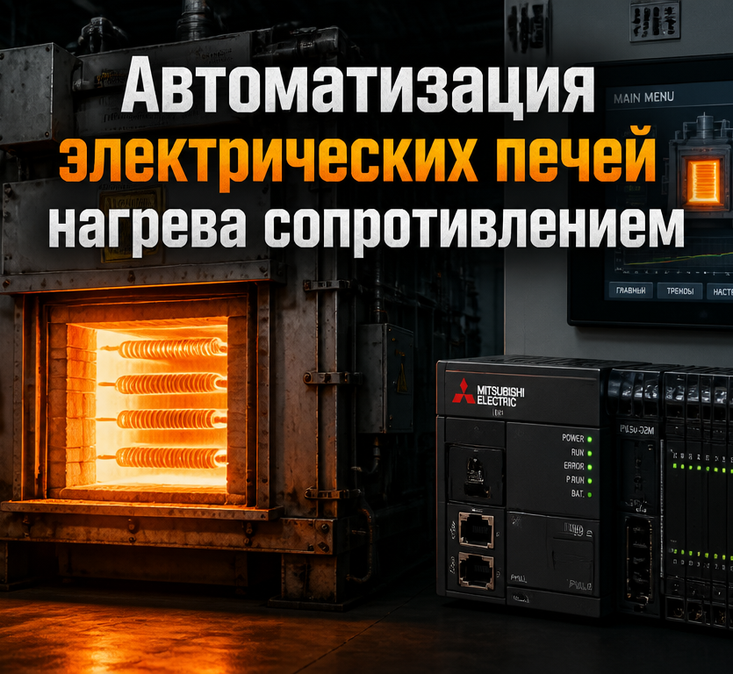
Electric resistance heating furnaces are key equipment in metallurgy, ceramics, glassmaking, food processing, and many other industries. Product quality directly depends on the accuracy and stability of the temperature regime. A control error can cost millions in spoiled products or lead to an accident.
This practical guide covers the complete development cycle of electric furnace control systems — from physical fundamentals to cloud integration. It systematically covers all aspects of creating a professional automation system using Structured Text (ST) according to IEC 61131-3.
The book covers in detail:
Physical fundamentals of electric furnaces — Joule-Lenz law, heating element types, thermal inertia, heating and cooling dynamics.
Key control system components — temperature sensors (thermocouples, RTD), actuators (contactors, SSR, phase-angle regulators), PLCs.
ST programming — syntax, data types, operators, functions and function blocks, analog signal processing (ADC, scaling, filtering).
Control algorithms — from simple ON/OFF to proportional (P), proportional-integral (PI), and full PID control with anti-windup and derivative filtering.
PID tuning — Ziegler-Nichols method, practical coefficient selection, static error elimination.
Single-zone electric furnace — complete control program with signal conversion, auto/manual modes, protection and indication.
Multi-zone furnace — independent control of three zones with individual PID controllers.
Cascade control — improved regulation quality through two-loop structure.
Protection and diagnostics — multi-level protection (hardware and software), sensor integrity checks, hard temperature limits.
SCADA and cloud integration — Modbus TCP and OPC-UA protocols, cloud data transmission, analytics and KPI in Python.
All algorithms are accompanied by ready-to-use ST code with detailed comments. The book contains numerous practical examples: from a simple ON/OFF controller to a complete three-zone furnace control system with cascade regulation, protection, and cloud integration.
The manual is intended for automation engineers, PLC programmers, commissioning engineers, students and teachers. It will help you master thermal process control system design — from concept to a complete industrial solution.
This practical guide covers the complete development cycle of electric furnace control systems — from physical fundamentals to cloud integration. It systematically covers all aspects of creating a professional automation system using Structured Text (ST) according to IEC 61131-3.
The book covers in detail:
Physical fundamentals of electric furnaces — Joule-Lenz law, heating element types, thermal inertia, heating and cooling dynamics.
Key control system components — temperature sensors (thermocouples, RTD), actuators (contactors, SSR, phase-angle regulators), PLCs.
ST programming — syntax, data types, operators, functions and function blocks, analog signal processing (ADC, scaling, filtering).
Control algorithms — from simple ON/OFF to proportional (P), proportional-integral (PI), and full PID control with anti-windup and derivative filtering.
PID tuning — Ziegler-Nichols method, practical coefficient selection, static error elimination.
Single-zone electric furnace — complete control program with signal conversion, auto/manual modes, protection and indication.
Multi-zone furnace — independent control of three zones with individual PID controllers.
Cascade control — improved regulation quality through two-loop structure.
Protection and diagnostics — multi-level protection (hardware and software), sensor integrity checks, hard temperature limits.
SCADA and cloud integration — Modbus TCP and OPC-UA protocols, cloud data transmission, analytics and KPI in Python.
All algorithms are accompanied by ready-to-use ST code with detailed comments. The book contains numerous practical examples: from a simple ON/OFF controller to a complete three-zone furnace control system with cascade regulation, protection, and cloud integration.
The manual is intended for automation engineers, PLC programmers, commissioning engineers, students and teachers. It will help you master thermal process control system design — from concept to a complete industrial solution.
Part I: Fundamentals of Electric Furnaces
Operating principle of resistance heating furnaces (Joule-Lenz law)
Heating element types (wire, tubular, ceramic)
Thermal inertia and time constant
Furnace dynamics during on/off switching
Part II: Programming Fundamentals
Structured Text (ST) — syntax, data types, operators
PLC introduction — architecture, scan cycle, manufacturers
Analog signal processing — ADC, scaling, filtering (moving average, exponential smoothing, hysteresis)
Part III: Control Algorithms
ON/OFF control — logic, hysteresis, disadvantages
P control (proportional) — formula, Kp selection, static error, feedforward
PI control — integral term, anti-windup, parameter selection
PID control — derivative term, derivative filtering, Ziegler-Nichols method
Part IV: Practical Systems
Single-zone electric furnace — complete control program, architecture, PID controller
Multi-zone electric furnace — three-zone control, individual PID controllers
Cascade control — outer and inner loops, improved regulation quality
Protection and diagnostics — protection hierarchy, sensor integrity checks, hard limits
SCADA and cloud integration — Modbus TCP, OPC-UA, cloud data transmission, analytics and KPI
Operating principle of resistance heating furnaces (Joule-Lenz law)
Heating element types (wire, tubular, ceramic)
Thermal inertia and time constant
Furnace dynamics during on/off switching
Part II: Programming Fundamentals
Structured Text (ST) — syntax, data types, operators
PLC introduction — architecture, scan cycle, manufacturers
Analog signal processing — ADC, scaling, filtering (moving average, exponential smoothing, hysteresis)
Part III: Control Algorithms
ON/OFF control — logic, hysteresis, disadvantages
P control (proportional) — formula, Kp selection, static error, feedforward
PI control — integral term, anti-windup, parameter selection
PID control — derivative term, derivative filtering, Ziegler-Nichols method
Part IV: Practical Systems
Single-zone electric furnace — complete control program, architecture, PID controller
Multi-zone electric furnace — three-zone control, individual PID controllers
Cascade control — outer and inner loops, improved regulation quality
Protection and diagnostics — protection hierarchy, sensor integrity checks, hard limits
SCADA and cloud integration — Modbus TCP, OPC-UA, cloud data transmission, analytics and KPI
No feedback yet